The Statue of Liberty is one of the most recognizable monuments in the world. Standing at the entrance to New York Harbor, she represents freedom, democracy, opportunity, and America itself. For generations of immigrants arriving by sea, the sight of Liberty meant a new life was close at hand. Yet immigration was not the statue’s original purpose. That meaning came later.
The idea originated in France in 1865 with Édouard de Laboulaye, a French legal scholar, abolitionist, and admirer of American democracy. The Civil War had ended, slavery had been abolished, and the centennial of American independence was approaching. Laboulaye proposed a French monument celebrating American liberty, Franco-American friendship, and the democratic ideals shared by both nations.
French sculptor Frédéric Auguste Bartholdi transformed the idea into Liberty Enlightening the World. France would create and finance the statue; Americans would provide the site and pay for its pedestal. Bartholdi visited America in 1871 and selected Bedloe’s Island in New York Harbor, where the monument would greet ships entering the nation’s busiest port.
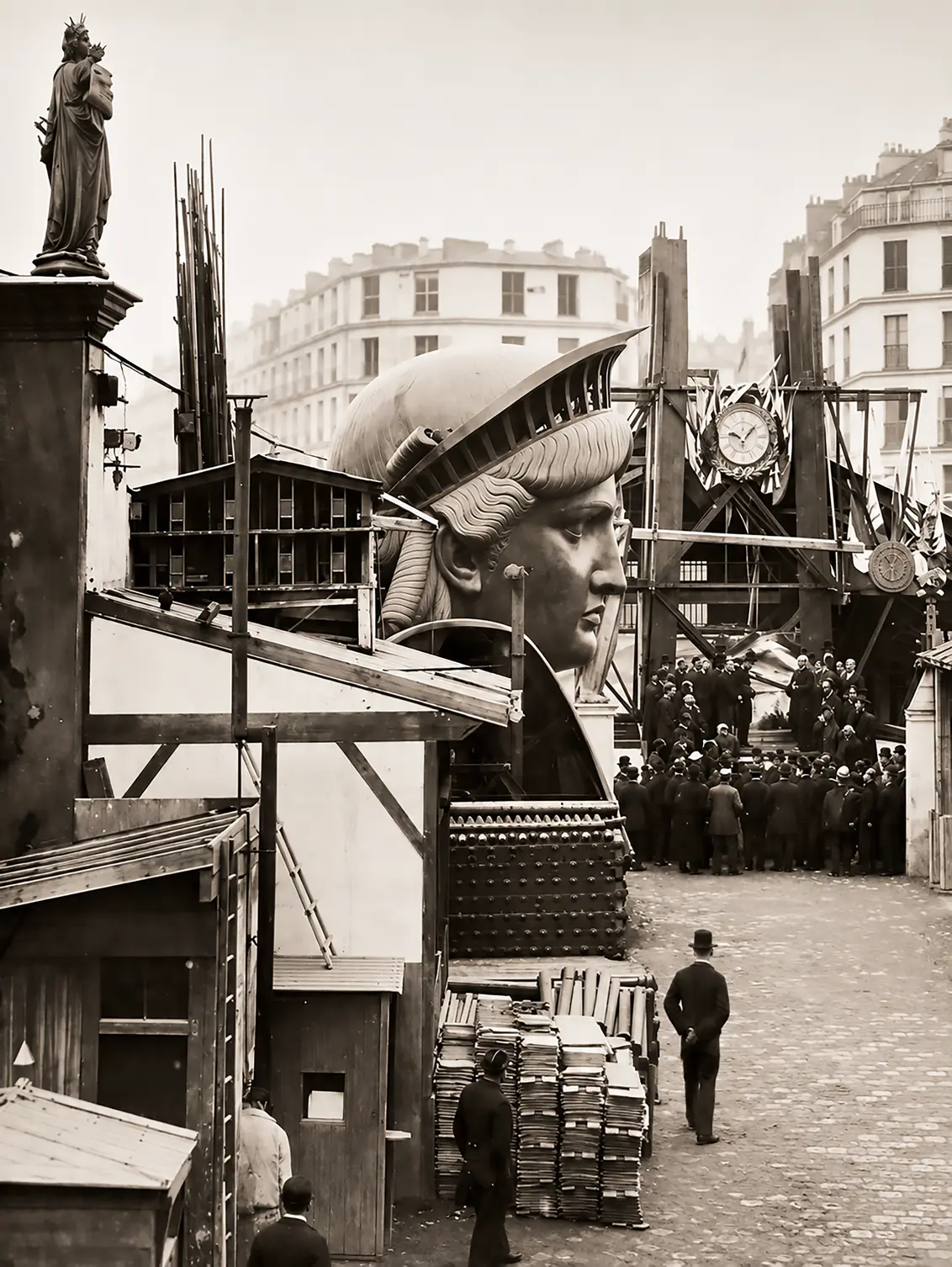
Construction began in France during the 1870s. Craftsmen used a traditional technique called repoussé, hammering thin sheets of copper into enormous forms to create Liberty’s face, robes, arms, and body. Supporting the copper skin required sophisticated engineering. Gustave Eiffel, later famous for the Eiffel Tower, and engineer Maurice Koechlin developed an innovative internal iron framework that allowed the exterior to move slightly with wind and changing temperatures. Liberty was a remarkable engineering achievement for its time.
Completed in France in 1884, the statue was dismantled and packed into 214 wooden cases. The pieces crossed the Atlantic aboard the French vessel Isère, arriving in New York on June 17, 1885. There was one problem: the pedestal was not finished.
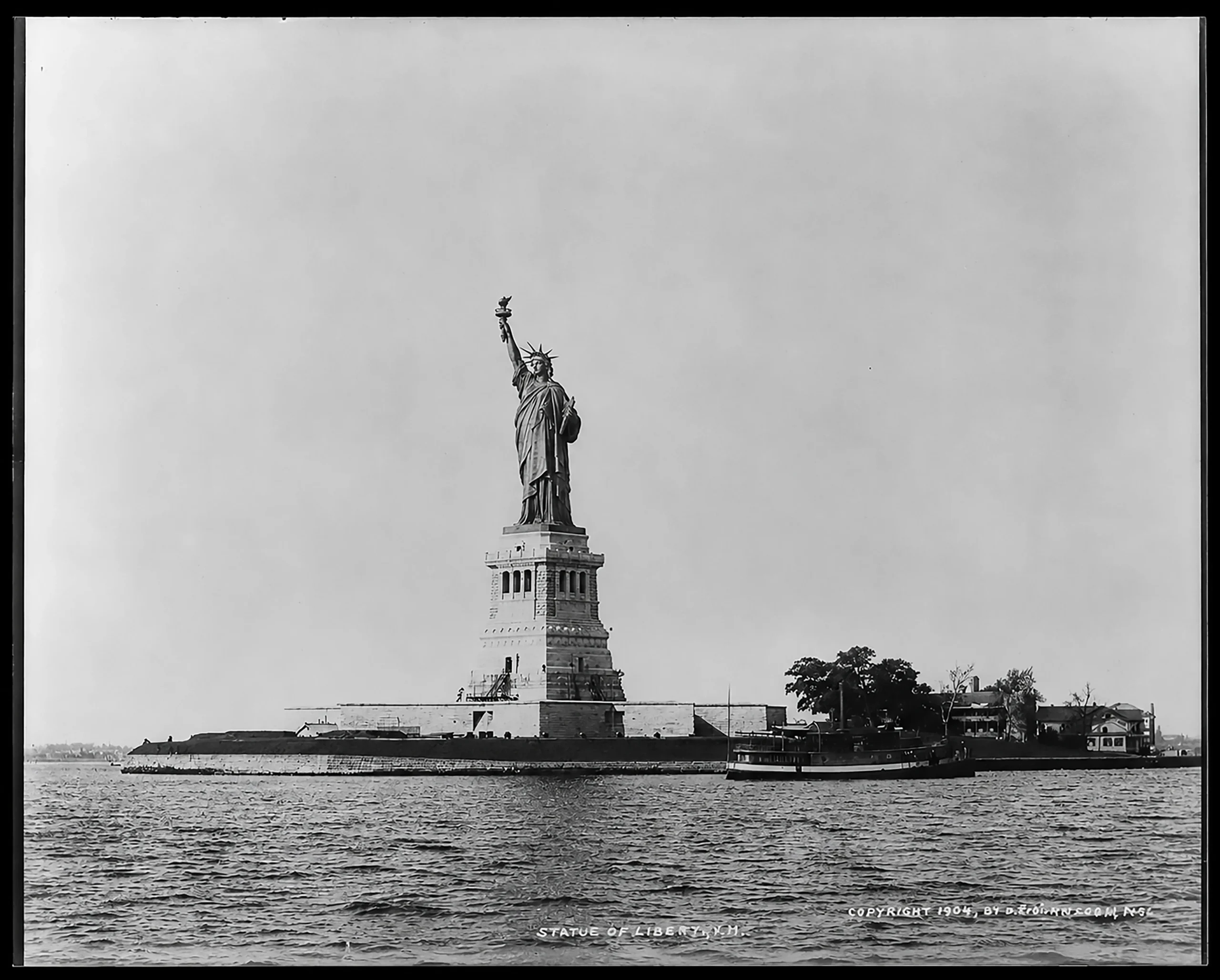
Architect Richard Morris Hunt designed the massive pedestal within the old star-shaped Fort Wood, but American fundraising had stalled. Newspaper publisher Joseph Pulitzer used his New York World to appeal directly to ordinary citizens. More than 100,000 people contributed, many less than a dollar. The pedestal was completed, Liberty was reassembled, and President Grover Cleveland dedicated the statue on October 28, 1886. From ground level to the tip of her torch, she stands approximately 305 feet.
The famous inscription associated with Liberty has a separate history. Emma Lazarus wrote The New Colossus in 1883 to help raise money for the pedestal. It was not part of Bartholdi’s original concept, and the poem’s famous words, “Give me your tired, your poor,” were not placed inside the pedestal until 1903—17 years after the statue’s dedication.
By then, Liberty’s meaning was changing. Ellis Island had opened nearby in 1892, and millions of immigrants passed the statue while entering America. A French monument celebrating republican liberty gradually became a symbol of welcome and opportunity. The statue and Lazarus’s poem began as separate creations but became inseparable in the American imagination.
Liberty underwent her most extensive restoration from 1984 to 1986, when deteriorating structural components were replaced and a new copper-and-gold-leaf torch was installed. The monument later closed following September 11, 2001, and during the COVID-19 pandemic. Today, visitors can enter the pedestal and, with advance reservations, climb to the crown. The torch remains closed to the public.